Why developments end exactly where places begin.
Every large mixed-use scheme makes the same promise at the planning stage. Homes, yes, but also the life around them. The cinema and the food hall. The nursery, the youth programme, the partnership with the local college. The square that holds a market on Saturdays and something worth walking to on a Tuesday night. That promise is what wins the committee vote and local residents’ support, because no one stands up at a consultation to demand more lettable floorspace. They want a place. So here is a test worth applying to any of these schemes, four years after the ribbon. Ask who is still economically on the hook for whether any of that life actually happened.
The answer is, surprisingly often, that no one is.
The structural problem is simple enough to state. A mixed-use development is two different things wearing one name. Up to completion, it is a development project with a developer, a funder, a programme and a defined end. After completion, it is an operating business, with a tenant mix to curate, public realm to programme, leisure and learning partnerships to hold together and the offer to change when the market says no. The people financed and incentivised to deliver the first are almost never organised to run the second. And I mean that literally. Most developers are organised to run a construction site, brilliantly, and nothing else. Which would be fine, except the community does not read it that way. When the retail turns out to be three chain units and a vacancy, when the ‘cultural quarter’ or the ‘academy’ is a locked room, residents do not blame some estate manager they have never heard of. They blame the name on the hoarding. The developer keeps the reputational liability for a place it stopped legally owning years ago, which is a strange bargain for everyone. The fix is hardly mysterious. Most developers should see the benefit of gearing up like an operator (whether in-house or through a capable partner) from consultation, through construction day one, to completion and beyond. A few do, but most sell the residential, forward-sell the freehold and the commercial to institutions, redeploy the delivery team to the next site and leave.
Meanwhile the place itself – the thing everyone at the planning committee spoke about with such feeling – is just starting to find out whether anyone wants it.
Three clocks run on every scheme, and they are badly aligned. The capital clock ends first, when the investment is recovered. The political clock peaks at announcement and again at opening, when the scheme is declared a success by people who will have moved on before the evidence arrives. The operating clock, the only one that measures whether the place works, starts after the other two have stopped. The industry has arranged its incentives around the first two clocks while treating the third as someone else’s problem. Usually, it is. That is my point.
The decade of the before photograph
Croydon is the cleanest case, because the operating clock never started at all. The £1.4bn redevelopment of the Whitgift Centre was announced in 2013 by the Croydon Partnership, a joint venture between Westfield’s owner Unibail-Rodamco-Westfield and Hammerson, and championed from the start by Boris Johnson as mayor and a succession of council leaders. The political clock ran gloriously for six years. The capital clock barely moved. The venture never reached financial close, URW took the scheme off its development pipeline in February 2020, planning lapsed the following year and in August 2021 the council’s own cabinet report pronounced it dead, taking an estimated £310m of anticipated business rates with it. Through all of it, the existing Whitgift Centre decayed because no retailer signs a long lease in a building scheduled for demolition, and no landlord refurbishes one. Croydon spent ten years as the ‘before’ picture of a transformation that stayed permanently “eighteen months away”. The town centre paid the cost of a regeneration that never physically existed.
The defenders will say the real culprits were structural. The big-box mall was a dying model, online retail was hollowing it out, the forced marriage (with political intervention) of two rival developers into a single 50-50 joint venture was dysfunctional from the start and a structural recipe for paralysis, and the new French owner decided after Brexit that south London was not worth the trouble. All true. But notice what every one of those reasons has in common. They are reasons the capital case fell apart. Not one of them was ever weighed against the operating life of the town centre, because in this model no one is asked to weigh it. The scheme was underwritten on the strength of the transaction, and when the transaction stopped making sense the partnership left, exactly as the structure permitted it to. The blight was the predictable cost of tying a living town centre to a purely transactional bet, with no one holding the downside if the bet came off the table. The developers were behaving precisely as the incentive structure told them to, rather than acting negligently. That is the more uncomfortable point, because negligence can be fixed with better developers. This type of impasse cannot.
Cardiff International Sports Village is the slower, and in a way more illustrative, version. An ice arena, a white-water centre and an Olympic pool did get built and do operate. But the wider waterfront masterplan, the one that promised a ski slope and later a velodrome, stalled when the private partners walked. Orion and its co-investor delivered the early pieces, then pulled out of the broader development agreement after the 2008 crash took the leisure-and-residential market with it. The velodrome plan was quietly shelved. The council, having sunk public money into a scheme that kept receding, was left holding the site. And here is the part a property audience should sit with. When Cardiff finally restarted the project, it did the one thing the original structure had not. It kept ownership of the land through every phase, deliberately, to stop a developer land-banking it and to force investment to be called down against a defined programme. In other words, the public owner, having been burned by disengagement once, rebuilt the deal so that it could drastically mitigate future loss of control of the operating outcome. Some detractors would point to this as a failure story. However, this is more a story of the public sector arriving, a decade and several million pounds late, at exactly the stewardship principle the private model had been organised to avoid. The private capital left when the capital clock stopped paying. The council stayed, because the council always stays. It lives on the operating clock whether it likes it or not, and this time it redesigned the contract to make sure the next partner would have to stay with it.
Even the schemes counted as successes carry a version of this. At Lendlease’s Elephant Park in south London, the Guardian reported in March 2024 that shared-ownership residents were facing service charges above £5,000 a year. What those charges pay for is revealing. The security patrols, the maintained public spaces, the amenities that the masterplan presented as the developer’s “gift” to the area. The place is still being made. The people who bought into the promise are the ones now funding it.
When someone stays
It can be done differently, and the proof is not theoretical. Grosvenor developed Liverpool ONE and then held it for a quarter of a century, curating, re-letting and reprogramming through every retail downturn Britain could supply. When it finally sold its stake to Landsec at the end of 2024, occupancy stood at 96.5 per cent against a national shopping-centre average of 86. At King’s Cross, Argent and its partners built on pension capital structured for decades, and the Centre for Cities found the number of firms on the estate doubled between 2010 and 2021, while office rents moved from 48 per cent below the London average to 19 per cent above. Neither place is perfect. But at both, someone stayed economically interested in the only question that matters, which is whether the thing works.
None of which is to say the developers are wrong. Their defence is rational and documented. Stewardship is a different business needing patient capital and skills a build-to-sell developer is not financed to acquire. The government’s own Living with Beauty review said as much. Fine. I have no quarrel with a developer who builds well, sells and leaves. My argument is with a system that prices the scheme at approval as though someone were staying. The National Audit Office has said plainly that the responsible department has not consistently evaluated its past interventions and cannot show whether billions in regeneration funding achieved what was intended. We fund delivery, photograph delivery, celebrate delivery, then look away at the precise moment the answer starts arriving.
You do not have to work in property to recognise this pattern. You have signed off the acquisition that was called complete on the day it closed, while the actual work of integrating the two companies had not even begun. You have seen the transformation programme declared a success the week the consultants left, before anyone had lived with what was re-built. Completion is the most seductive metric in any organisation, because it is the one moment everyone can agree the job is done. It also tends to arrive just before the truth does.
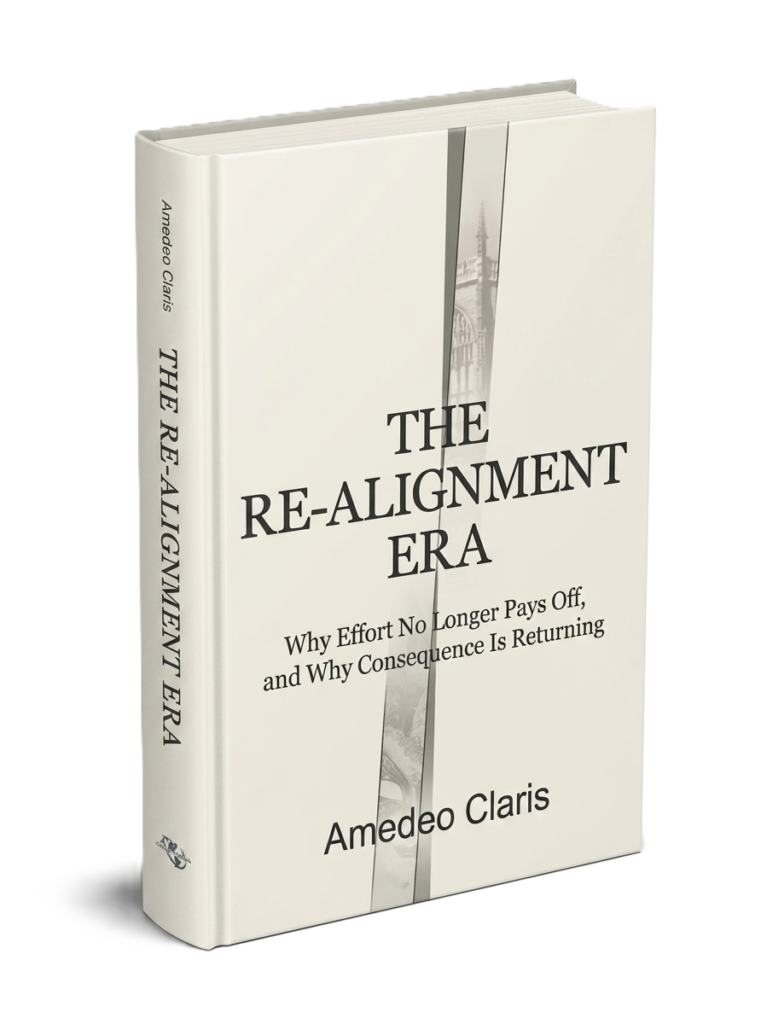
The mechanism underneath – a correction deferred until it arrives at the scale the delay made necessary – sits at the centre of my book, The Re-Alignment Era, where Chapter Ten traces how accountability distributed until no one owns it produces exactly this outcome.
The ribbon is the moment the scoreboard should be switched on. Most schemes treat it as the finish line.