THE BOOK
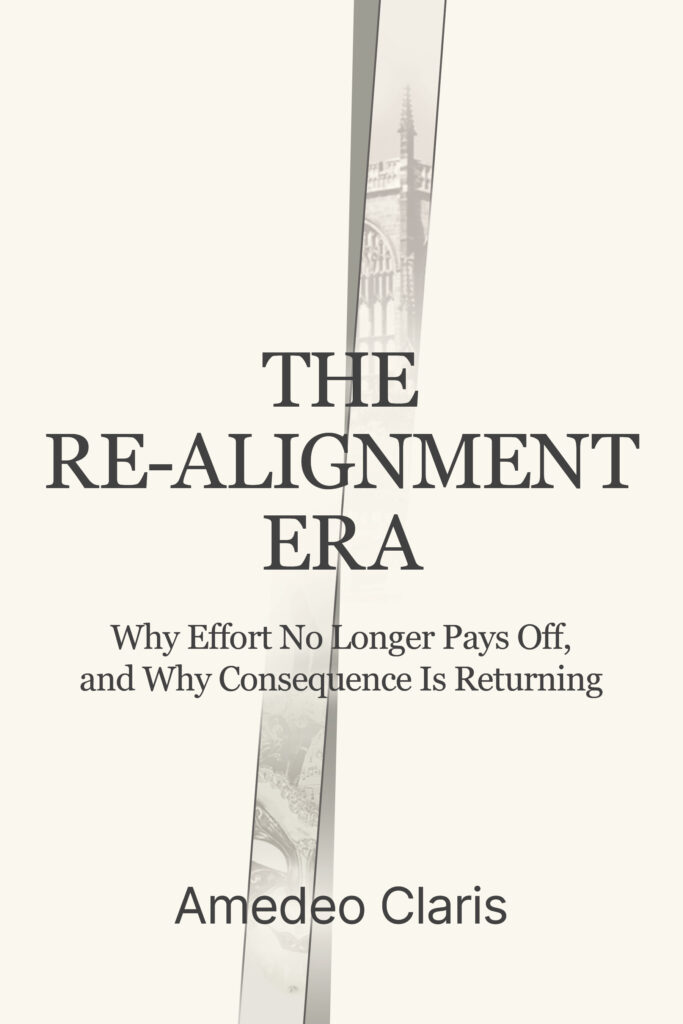
The Re-Alignment Era
Why Effort No Longer Pays Off, and Why Consequence Is Returning
Amedeo Claris




The Core Thesis of the Book
Something happened to the link between effort and outcome. It did not break suddenly. It eroded through mechanisms that were, individually, entirely rational. Protections absorbed consequence. Credentials outlived the standards they once certified. Recognition systems rewarded the performance of progress over its substance. The result is an economy in which the rational survival strategy is to perform alignment rather than produce it.
The Re-Alignment Era names those mechanisms precisely. Part I traces how the link between effort and outcome was broken and why the evidence of that failure was invisible for so long. Part II replaces the reader’s existing understanding of power, time, and leverage with a structural account of how each actually operates. Part III introduces the Re-Alignment Discipline — not as a programme, but as the only structural position that addresses the condition the book has documented.
The Re-Alignment Discipline has three components. Judgment determines where effort goes. Leverage determines whether that effort compounds. Consequence acceptance determines whether the feedback from outcomes is received and acted on. These are not habits. They are not routines. They are the conditions under which effort and outcome reconnect.
The Re-Alignment Era is not a self-help book. It does not offer reassurance. It does not prescribe a better morning routine or a more productive mindset. It offers a structural account of the conditions most professionals currently inhabit, and a precise description of what it takes to operate differently within them.
The Book in Three Parts
Part I
The Broken Link
Six chapters
The historical and structural account of how consequence was diluted, how the performative economy emerged, and why its failure became unavoidable.
01 When Effort Still Paid
02 Why Order Was Necessary
03 When Structure Began to Soften
04 The Dilution of Consequence
05 The Moment the Mask Slipped
06 The Inescapable Return of Consequence
Part II
Power, Time & Structure
Nine chapters
The structural account of power, leverage, time, hierarchy, and institutions — replacing the reader’s existing model with a precise account of how each actually operates.
07 Power Is Not What You Think It Is
08 Time Is the Ultimate Enforcer
09 Leverage Beats Effort
10 Hierarchy Is Not the Enemy
11 Institutions Are Memory Machines
12 Leverage Without Myth
13 Severance from Validation
14 Technology Does Not Rescue You
15 Freedom Without Structure Is Noise
Part III
The Re-Alignment Discipline
Five chapters
The Discipline introduced only after illusion removal is complete. The three-component structural practice that restores the link between effort and outcome.
16 The Choice to Re-Align
17 Judgment Before Action
18 Total Responsibility Without Appeal
19 The Identity Fallacy
20 Living Under Consequence
What readers have said
"As a filmmaker, I was struck. Read this now."
Had I read this book in 1992 when I started Raindance, I, and Raindance, would be in a much happier place. Amedeo Claris succinctly and eloquently cuts a swathe through the toxic environment our political and corporate systems have laid before us. As a storyteller and filmmaker myself, I was struck by how Claris uses the power of story to illustrate his points and clarify his themes – and his themes are based on cold hard facts. The magic of this book is that he makes each point easy to understand and, in this era of oversupply, easily digestible and, more importantly, rememberable.
Read this now.
ELLIOT GROVE
- Founder, Raindance Film Festival and BIFA
"An autopsy of how institutions quietly rewrote the rules of consequence"
A forensic autopsy of how institutions quietly rewrote the rules of consequence, both incrementally and invisibly. After reading this book, I started looing at comfortable policies with deeply discomfort.
R.J. WHEELER
- Political COMMENTATOR
"Smarter not harder"
If you’ve ever felt like you’re working harder than ever but just spinning your wheels, you need to read this book. Amedeo Claris explains that we’ve entered a ‘performative economy’ where looking productive and hitting metrics has replaced actually getting things done. He calls this the ‘theatre of effort,’ and it’s the perfect description for why so many of us are stuck.
The book is full of fascinating, and sometimes pretty intense, stories ranging from the ‘Boeing 737 MAX’ disaster to the fall of ‘Nokia’ to show exactly what happens when systems lose touch with real consequences. One of the most eye-opening parts for me was his take on ‘AI’; he argues it isn’t a magic fix, but a ‘stress test’ that reveals which tasks were just ‘process’ without any real substance.
This isn’t your typical ‘hustle harder’ guide. Instead, it’s about learning how to build ‘leverage’ so your effort actually compounds over time instead of just being a one-off ‘expenditure’ of energy. The ‘Re-Alignment Discipline’ framework (Judgment, Leverage, and Consequence) gives you a practical way to stop ‘consuming ambition’ and start building something that lasts. This is a clever new paradigm.
It’s a bit of an uncomfortable read at times because it forces you to look at your own position very clearly, but it is easily the most ‘clarifying map’ I’ve found for navigating work today. If you want to understand how power and success actually work in the real world, buy this book.
JULIE ANDRESHAK-BEHRMAN
- Chief Academic Officer and Provost, Foundation for International Education
"Connects to work, finances and news. Never lost me once"
Honestly one of the best books I’ve picked up in a long time. What makes it work is how it connects to things at work, in your finances and in the news you actually recognise. I came to it with no background in any of this and it never lost me once.
SUSIE WOOLCOTT
- Fractional Head of People
"Excellent"
ROBERT MACHIN
- CO-FOUNDER AND DIRECTOR, REIMAGINE CITY